
By Marçal Santos, CISO and founder of SecureLeap. CISM and CDPSE (ISACA). Previously security roles at Aircall, Citibank and Talkdesk. 20+ years in cybersecurity. Leads every SecureLeap penetration test engagement, delivered with vetted specialist testers.
Astra Pentest is a good fit for a startup with one main web app that wants a vulnerability scanner and a yearly pentest report in one dashboard: the manual plan lists at $5,999 a year per target, and G2 users rate it 4.6 out of 5 from 256 reviews. Two catches decide whether it stays good value. Astra prices per target, so an iOS app, an Android app, a standalone API and a cloud account each add to the bill. And on the Auto and Expert plans, re-scans after your fixes must happen within 30 days.
Quick answer: Astra Security sells a penetration testing platform that combines an automated scanner, an autonomous AI pentest and manual pentests by certified testers. Pentest Auto (autonomous) costs $2,999 a year per target, Pentest Expert (manual plus unlimited scans) costs $5,999 a year per target, and Enterprise starts at $9,999. It holds CREST Penetration Testing accreditation and scores 4.6 out of 5 on G2 from 256 reviews, with support as the most praised feature. It fits startups with one main app that want testing as a subscription; check what counts as a target, the re-scan window and the timeline before you sign.
"Most startups don't need the biggest firm. They need a test sized to their product, a report their auditor accepts the first time, and a retest that proves the fixes held," says Marçal Santos, CISO and founder of SecureLeap.
A disclosure first: SecureLeap sells penetration tests, so we compete with Astra. To keep this Astra Pentest review fair, every figure below comes from Astra's own pricing page, the CREST register, G2 and Capterra, checked on October 2026, and the one section where we compare ourselves is clearly marked. Review themes come from G2's topic counts, the 10 reviews on the first page of G2's default sort and Capterra's 12 reviews.
Astra Pentest review at a glance
What is Astra Security?
Astra Security is a penetration testing company that sells testing as a subscription platform, a model often called PTaaS (penetration testing as a service). One dashboard holds four products: a DAST vulnerability scanner for web apps, an autonomous AI pentest powered by what Astra calls Attack AI, manual pentests by its own testers, and separate API and cloud scanners. Findings from all of them land in the same list, with fix guidance and Jira, Slack, GitHub, GitLab and CI/CD integrations.
The company trades as ASTRA IT, Inc. It was founded in 2018 by Shikhil Sharma and Ananda Krishna, was backed by Techstars early on, and raised $2.7 million in February 2025 in a round led by Emergent Ventures. G2 lists its headquarters in Bengaluru, India; the CREST register lists it in the United States with 50 to 99 employees. Astra says more than 1,500 organizations in over 70 countries use it.
The accreditations are real. Astra holds CREST accreditation for Penetration Testing, is empanelled by CERT-In (India's national computer emergency response team) and is a PCI Approved Scanning Vendor. For a startup, these matter less than they sound: SOC 2 and ISO 27001 auditors read the scope, method, findings and retest evidence in the report, not the badge on the vendor's website (SOC 2 penetration testing requirements).
What Astra is not: an auditor. Its plans include a pentest report you can hand to a SOC 2 or ISO 27001 auditor and a "publicly verifiable pentest certificate". The certificate is a sales asset for your website and security page. Your auditor and your enterprise customers' security teams will ask for the report.
Astra pricing in 2026: what each plan buys
Astra publishes list prices on its pricing page, with five plans that matter for a startup. Every price is per target, and the pentest plans are sold as yearly subscriptions:
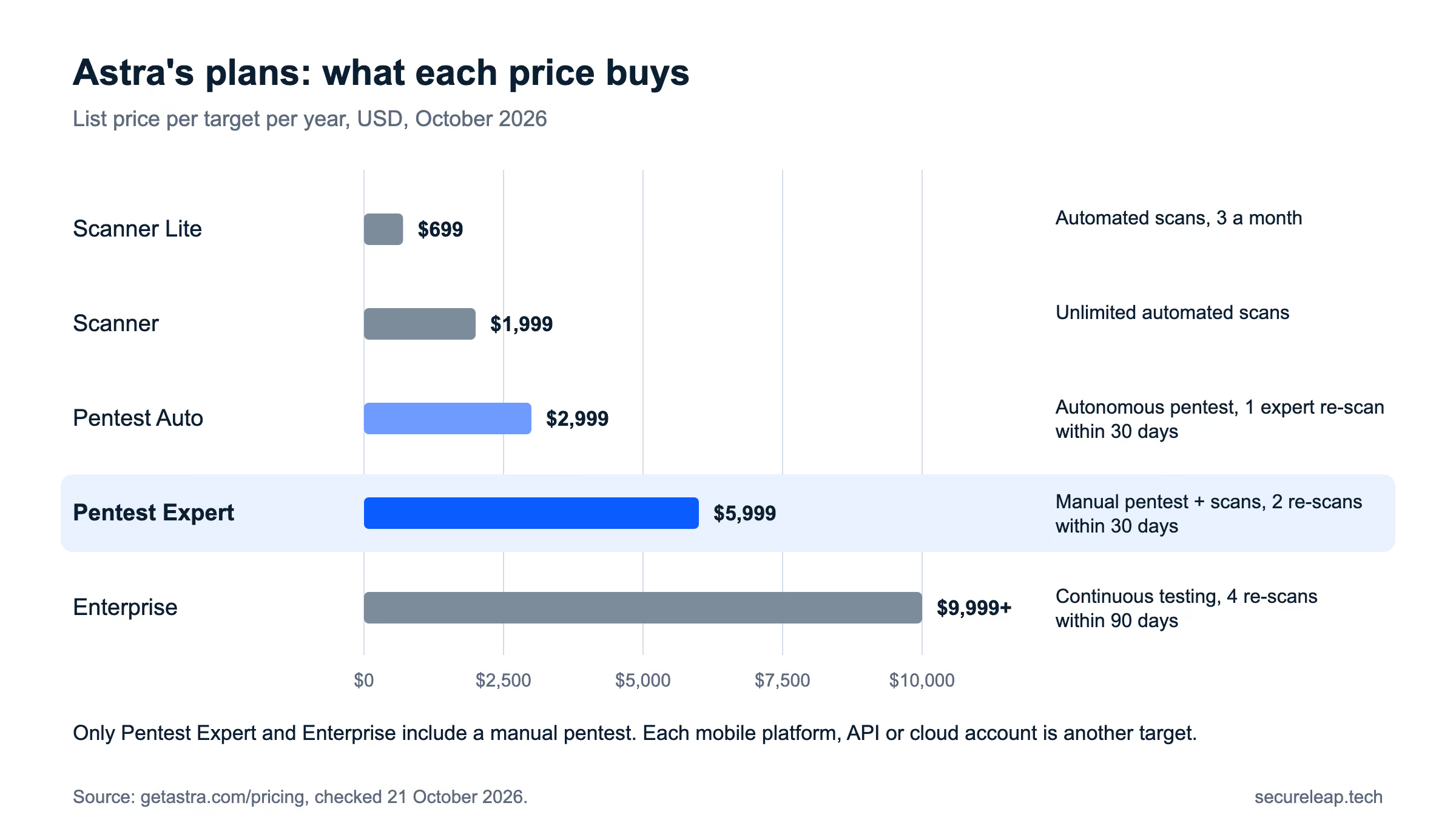
Three details change what you pay:
- Pentest Expert has no monthly option. You commit to 12 months up front. Pentest Auto can be bought at $199 a month.
- Discounts exist. G2 reviewers report an average discount of 9%, and Astra's pricing FAQ says it offers better terms on multi-year contracts. Ask for both.
- Manual testing starts at Pentest Expert. On Pentest Auto the testing is autonomous; a human only re-checks your fixes, once. On the Scanner plan, Astra experts vet 4 scans a year to remove false positives.
What counts as a target
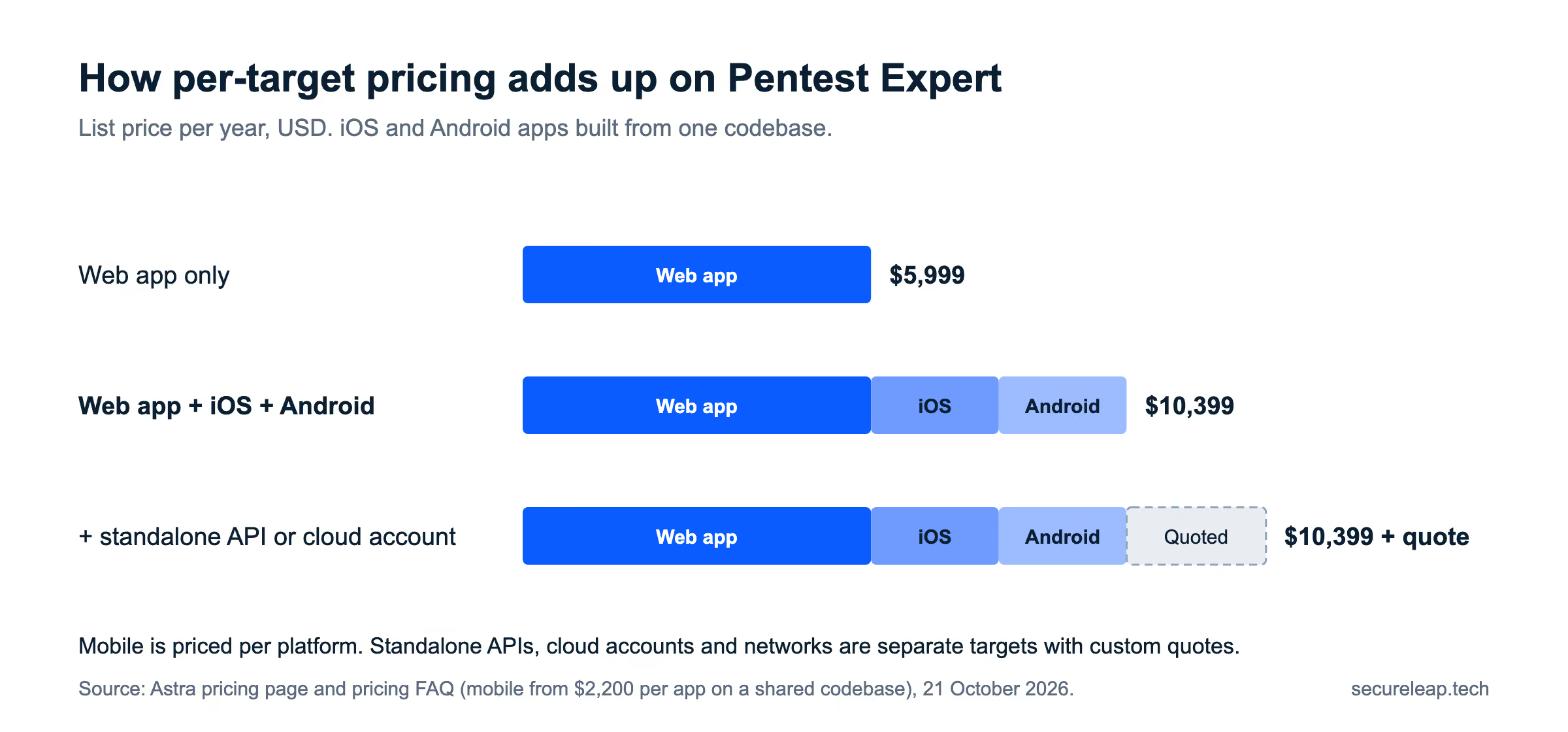
This is the line that decides your real bill. Astra's pricing FAQ defines a target like this:
For a startup with one web app, $5,999 is the whole manual pentest price. For a typical product with a web app and iOS and Android apps built from one codebase, Pentest Expert starts at $10,399 a year at list, and a standalone API or a cloud account is quoted on top.
Compare that with a one-off pentest priced by scope: most startups pay $4,000 to $12,000 to test one web app and its API, depending on size and depth (penetration testing cost guide). For one simple app tested every year, Astra's $5,999 sits inside that range and also buys a year of scanning. The model loses its edge once the product spans several platforms, or if you need one test a year and no scanner.
Pentest Auto vs Pentest Expert: autonomous or manual?
Pentest Auto runs Astra's AI agents against one target as a role-based grey box test. They map the app, attempt exploits and report what worked, with the first report on the same day, and an Astra expert re-scans once to confirm your fixes. Astra claims the autonomous test reaches the depth of a two-week human pentest. That is fast, and an autonomous test that proves its exploits produces far fewer false positives than a plain scan (vulnerability scan vs penetration test).
Pentest Expert adds a manual pentest by Astra's certified testers, aligned with OWASP, PTES and SANS, plus unlimited automated scans and a named account manager. Astra's pricing FAQ says the manual pentest takes 10 to 15 working days.
The choice comes down to what you need to prove:
- A report for a first SOC 2 or ISO 27001, or a fast check before a release: an autonomous test is usually enough. In our experience, auditors accept automated and AI-driven pentest reports when they show scope, method, findings and retest evidence.
- Confidence that customers cannot reach each other's data: buy a manual test. Business logic flaws, broken authorization between roles and cross-tenant access need a human who tries the app the way an attacker would (automated vs manual penetration testing).
- An enterprise customer's security review or due diligence: buy a manual test. Enterprise security reviews usually ask who performed the test and which method they followed, not just for a findings list.
What users say: Astra Pentest reviews on G2 and Capterra
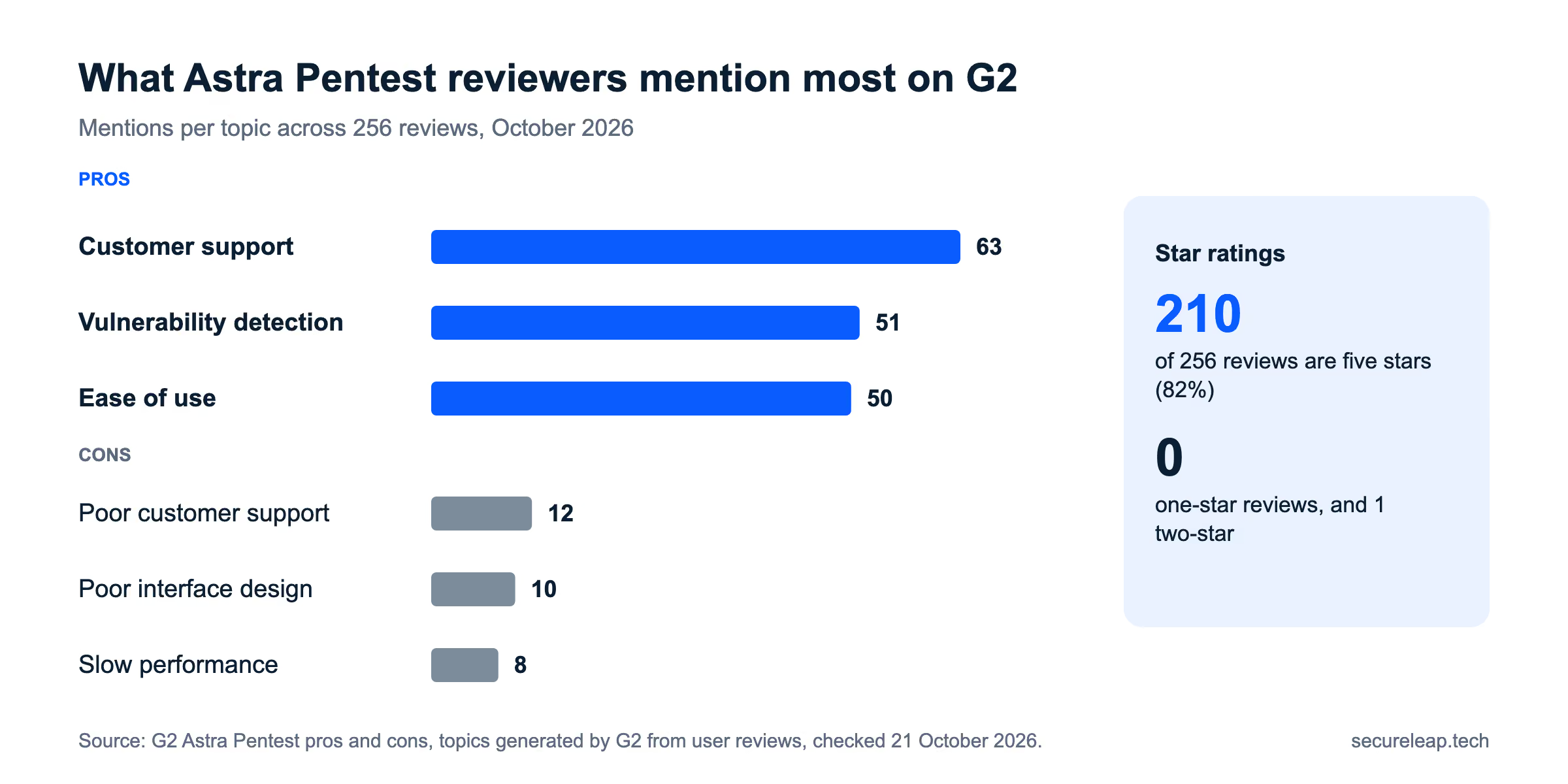
On G2, Astra Pentest holds 4.6 out of 5 from 256 reviews: 210 five-star, 41 four-star, 4 three-star, 1 two-star and no one-star reviews. Small businesses with 50 or fewer employees wrote 68.5% of them. On Capterra it scores 4.8 out of 5, but from only 12 reviews.
G2 shows Intruder as Astra's closest rival. Intruder scores higher on ease of use, setup and support, while reviewers report a faster return on investment with Astra (G2 comparison):
What reviewers like
- The people. Customer support is the most tagged pro on G2 (63 mentions), and many five-star reviews name their account manager or pentest coordinator. Reviewers describe quick answers on Slack and testers who explain findings to engineers.
- Clear findings. Reviewers praise reproduction steps and suggested fixes for each issue, which shortens remediation.
- Speed under deadline. Several reviews describe Astra fitting a pentest, fixes and the final re-scan into a tight launch or compliance date.
What reviewers dislike
- Chasing rechecks. The cons repeat one pattern: reviewers had to follow up with support to get testers to recheck fixed issues or confirm statuses. A mid-market reviewer who still gave 5 stars describes "occasional delays where we need to follow up with the support team". G2 groups these under poor customer support (12 mentions).
- The interface. Poor interface design (10 mentions) and slow performance (8 mentions) come next, including unclear rescan needs during a pentest. On Capterra, the main complaint is that reports show resolved issues by default.
- Reports that change. One reviewer who shares Astra reports with customers says the report layout changed over time and now includes links back to the platform by default.
Read the ratings with one caveat. Of the 10 reviews on the first page of G2's default sort on 21 October 2026, 9 came through an invitation from Astra, which G2 allows and labels; one of those was marked incentivized. The tenth was organic but came from a business partner of Astra, which G2 excludes from its scores. Invited reviews skew positive for every vendor, so weigh the specific complaints more than the star average.
5 catches to check before you sign
- Pricing is per target. Your web app is one target. Each mobile platform, standalone API, cloud account and network is another. List every asset your customers or auditor expect tested and get a quote for all of them, not just the headline $5,999.
- The re-scan window is 30 days. Pentest Expert includes 2 re-scans and Pentest Auto 1, both within 30 days; only Enterprise gives 4 re-scans within 90 days. A critical finding in authorization or tenant isolation can take a sprint or two to fix properly, so ask what happens to your report if a fix lands on day 35.
- You pay for 12 months before the first finding. Pentest Expert is billed yearly only. That suits a team that wants the scanner all year; it is poor value if you need one test for one audit.
- The manual test takes 10 to 15 working days. Astra's EU page promises an initial report in 2 to 7 days, but its pricing FAQ puts the full manual test at 10 to 15 working days. Add scoping, fixes and re-scans and plan for about a month from signature to final report. If an auditor or customer deadline is close, agree the start date in writing.
- EU buyers get USD pricing and few details. Astra's EU landing page does not name DORA or NIS2, and does not say where test data is hosted or where testers are based. If GDPR data transfers or a regulator matter to you, ask for the hosting region, the tester locations and the sub-processor list before you sign.
Who should choose Astra, and who should look elsewhere
Astra fits you if:
- You have one main web app and want automated scanning between yearly pentests
- Your engineers want findings in Jira, Slack or the CI/CD pipeline, not in a PDF
- You need CERT-In empanelment for Indian customers, or PCI ASV scans from the same vendor
- You can fix critical findings within 30 days
Look elsewhere if:
- You need several platforms tested once a year: per-target pricing adds up fast
- Your app has complex roles or multi-tenant data and you need more time to fix and retest
- You want a one-off test for a single audit, without a subscription
- You need an EU-based testing partner, a EUR contract or answers on DORA and NIS2
Astra vs SecureLeap: where we fit
This is the section where we compare ourselves, so read it knowing that SecureLeap competes with Astra.
SecureLeap sells the same two kinds of test as Astra, but per test instead of per year. Both are scoped on the same free call:
Astra prices in USD and SecureLeap's manual pentest in EUR, so compare them at the exchange rate of the day. The bigger difference is the model:
- One-off, not a subscription. You pay for the test you need, when you need it. If you want automated scanning all year, Astra or a dedicated scanner is the better buy; SecureLeap does not sell continuous monitoring.
- More time to fix. Manual tests include unlimited retests for 60 days, and the AI pentest one free retest within 60 days.
- Manual testing starts fast. Most manual engagements start within 2 business days of the scoping call, and findings come in real time so your engineers can start fixing before the report arrives. The API and web app pentest case study shows how one ran.
- Built around compliance. Reports are formatted for SOC 2 and ISO 27001 evidence, and the same team runs SOC 2 and ISO 27001 programs, so the pentest scope matches the audit scope.
SecureLeap is a boutique based in Porto, Portugal. It is built for startups and small companies, not for large enterprises with dozens of applications.
Questions to ask Astra, or any pentest vendor, before you sign
- Which of our assets count as separate targets, and what is the total price for all of them?
- Is the test manual, autonomous or both, and who reviews the findings?
- How many retests are included, and how long do we have to fix?
- When can testing start, and when will we get the final report?
- Where are the testers based, and where is our test data stored?
- Can we see a redacted sample report? Our pentest report guide shows what a good one contains.
Comparing more providers? See the best penetration testing companies in Europe and the best penetration testing companies for US startups, or our penetration testing guide for startups for scoping and timing.
Need a pentest for SOC 2, ISO 27001 or a customer review? Tell us what you need to prove and we recommend the test that fits: a manual grey box pentest from EUR 3,999 with unlimited retests for 60 days, or an AI pentest of one target for USD 2,899 with one free retest within 60 days. Both start with a free 30-minute scoping call and a fixed price. Book a scoping call with SecureLeap's pentest team.
Sources
- Astra pricing page and pricing FAQ: plans, prices, re-scans, target definition, manual test duration
- Astra EU landing page: initial report time, EU claims
- G2 Astra Pentest reviews and pros and cons: rating, star split, review topics, reviewer quotes
- G2 Astra Pentest vs Intruder: sub-scores, time to implement, return on investment, discounts
- Capterra Astra Pentest: rating and complaints
- CREST supplier register: accreditation, location, company size
- Entrepreneur India: founders and the February 2025 funding round
Frequently asked questions
Is Astra Pentest any good?
Yes, for startups with one main web app that want a scanner and a yearly manual pentest on one dashboard: it holds 4.6 out of 5 on G2 from 256 reviews. It gets expensive as you add mobile apps, APIs and cloud accounts, because each one is priced as a separate target.
How much does Astra Pentest cost?
Astra lists Pentest Auto, an autonomous test, at $2,999 a year per target and Pentest Expert, a manual pentest, at $5,999 a year per target. Enterprise starts at $9,999 a year, and the scanner alone starts at $699 a year.
Is the Astra pentest manual or automated?
It depends on the plan: Pentest Auto tests autonomously and an Astra expert re-scans your fixes once, while Pentest Expert adds a manual pentest by certified testers and unlimited vulnerability scans. Business logic flaws, such as one tenant reaching data that belongs to another, need the manual plan.
Does an Astra pentest report work for SOC 2 and ISO 27001?
Yes, Astra pentest plans include a report for SOC 2 and ISO 27001, and auditors accept automated and manual reports that show scope, method, findings and retest evidence. The public pentest certificate is a sales badge, so give your auditor the full report.
Where is Astra Security based?
Astra Security trades as ASTRA IT, Inc., was founded in 2018 and is backed by Techstars; G2 lists its headquarters in Bengaluru, India, and the CREST register lists it in the United States. If you need EU data hosting or testers in a given country, ask for both in writing before you sign.
What are the best Astra Pentest alternatives?
For continuous scanning, Intruder scores higher than Astra on G2 for ease of use and support (4.8 from 222 reviews). For a one-off test without a subscription, boutique firms such as SecureLeap price per test, from EUR 3,999 for a manual pentest or USD 2,899 for an AI pentest.