

The best penetration testing companies in Europe and the UK for startups in 2026 are SecureLeap (from EUR 3,999 per test), Vaadata, Precursor Security, OnSecurity and Tripla Consult. For large enterprises and regulated multinationals, NCC Group, Redscan (Kroll) and SySS are the stronger fit.
By Marçal Santos, CISO and founder of SecureLeap. CISM and CDPSE (ISACA). Previously security roles at Aircall, Citibank and Talkdesk. 20+ years in cybersecurity and more than 30 SOC 2 audits led over his career.
For a startup, the right choice is rarely the biggest name. What decides it is whether the firm takes a scope as small as one web app, what a test costs, whether retests are included, and whether the report holds up with your SOC 2 or ISO 27001 auditor and with your customers' security reviewers.
This list compares 11 penetration testing firms across the EU and the UK on exactly those points. SecureLeap is one of them and ranks first for startups and small companies. To keep that fair, every entry, ours included, lists strengths, limitations and who it suits, based on what each company publishes (checked October 2026).
Based in the US? See the best penetration testing companies for US startups.
Quick answer: the best penetration testing companies in Europe and the UK
- SecureLeap (Portugal): best for startups and small companies that need an audit-ready pentest, from EUR 3,999 per test.
- Vaadata (France): best for French companies that need a PASSI-qualified provider.
- Precursor Security (UK): best for UK companies that want CREST testing with published prices.
- OnSecurity (UK): best for engineering teams that want to book and track tests in a platform.
- Tripla Consult (Denmark): best for Nordic startups that want a pentest and compliance support from one local firm.
- Outpost24 (Sweden): best for teams that release every week and want continuous testing.
- SySS (Germany): best for German-speaking companies that want a BSI-certified specialist.
- WorkNest Secure (UK): best for UK organizations that need CHECK-accredited testing.
- Redscan, part of Kroll (UK): best for companies that want testing and incident response from one group.
- NCC Group (UK): best for large enterprises and regulated multinationals.
- Pentest-Tools.com (Romania): best for in-house security engineers who run their own scans.
How we evaluated these companies
We compared every company on six facts you can check before you sign:
- Fit for small scopes: a fixed-scope test of one web app or API, at a price a seed or Series A company can pay.
- Testing model: manual testing by certified consultants, a continuous testing platform (PTaaS), or self-serve tools you run yourself.
- Verifiable accreditations: company accreditations such as CREST, the UK's CHECK, France's PASSI or Germany's BSI certification, plus individual certifications such as OSCP.
- Pricing transparency: a published price or day rate, or a quote only after a sales call.
- Retests: whether checking your fixes is included or sold as a second engagement.
- Audit-ready reporting: whether the report works as evidence for SOC 2, ISO 27001, NIS2 or DORA, and for customer security questionnaires.
Startup fit carries the most weight, so firms that serve small companies well rank higher. The large consultancies sit lower because they are built for a different buyer, not because their testing is weaker.
Penetration testing companies in Europe compared
Accreditations and prices as each company publishes them, checked October 2026. Verify accreditations in the CREST, NCSC CHECK, ANSSI PASSI and BSI registers before you sign.
The 11 best penetration testing companies in Europe and the UK
Ordered by fit for startups and small companies.
1. SecureLeap (Portugal): best for startups and small companies
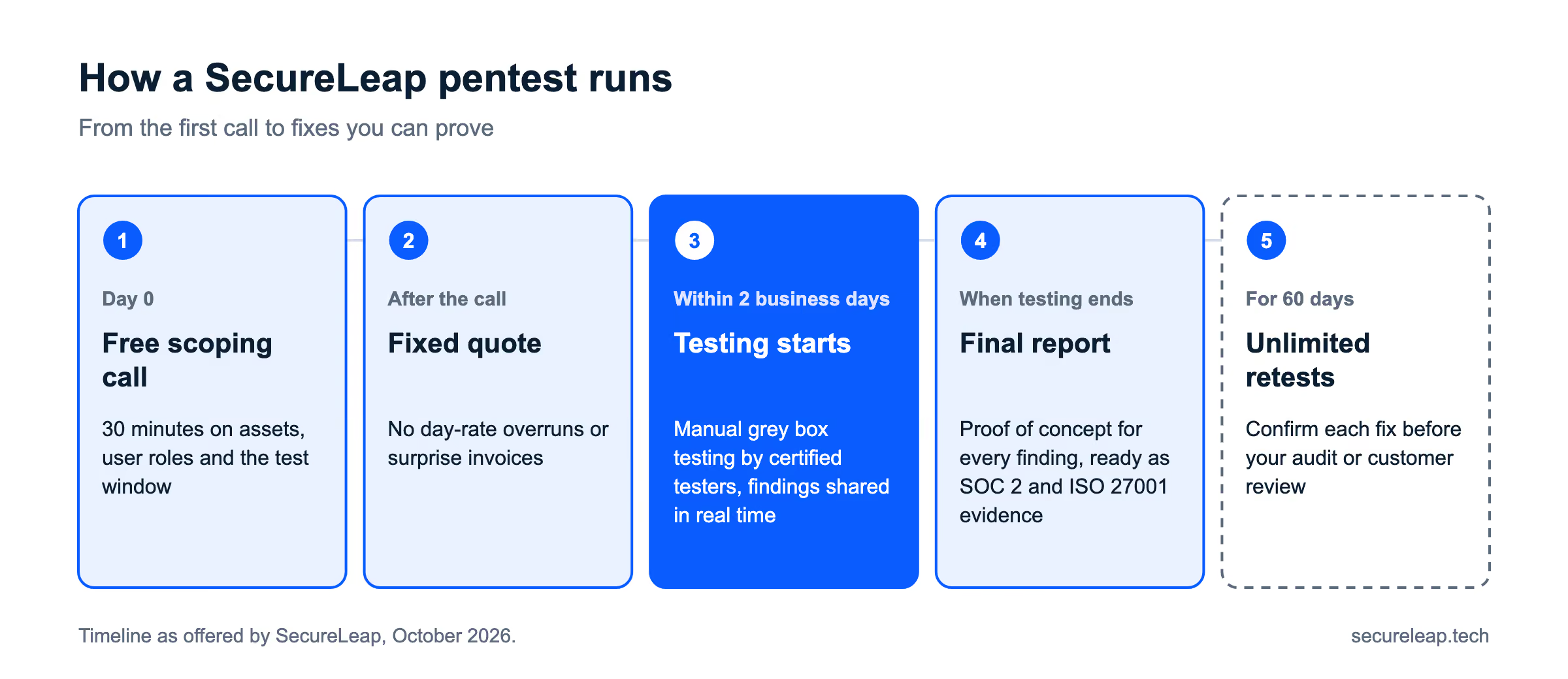
SecureLeap runs manual, grey box penetration tests for startups and small companies. It is based in Porto and works remotely with clients across the EU, the UK and the US. Testing covers web applications, APIs, cloud environments (AWS, Azure, GCP), mobile apps and network segmentation, and the report is formatted for direct use as SOC 2 and ISO 27001 evidence, in vendor security reviews and in due diligence.
The work is done by certified penetration testers (OSCP, eWPTX, CPENT, CompTIA PenTest+, eMAPT, CRTP). You get findings in real time during the test, so your engineers can start fixing before the report arrives, and every finding in the report comes with reproducible proof of concept. The API and web app pentest case study shows how this ran for an EU startup.
Strengths
- Pricing built for small companies: from EUR 3,999 per test, at a fixed price agreed after a free scoping call.
- Unlimited retests for 60 days, so you can show your auditor and customers that the fixes hold.
- A fast start: most engagements begin within 2 business days.
- One partner for the pentest and the compliance work around it: SOC 2, ISO 27001 and virtual CISO support.
Limitations
- No continuous monitoring: recurring tests can run quarterly, but there is no always-on scanning or PTaaS dashboard between them. If you release every week and want testing in between, look at Outpost24 or OnSecurity.
- Not built for large enterprises: multi-country programs, large red team exercises and 24/7 managed detection and response are better served by NCC Group or Redscan (Kroll).
Choose someone else if you need CHECK-accredited testing of UK government systems (WorkNest Secure or NCC Group) or a PASSI-qualified provider in France (Vaadata).
2. Vaadata (France): best for French companies that need a PASSI provider
Vaadata is a penetration testing company based in Lyon that reports more than 800 clients of all sizes, in France and abroad. It tests web and mobile apps, cloud, infrastructure, IoT and LLM-based applications, and also runs social engineering, red team and assumed breach exercises.
The company lists CREST, ANSSI PASSI and ISO 27001, and its consultants hold certifications such as OSCP, CPTS and CRTO.
Strengths
- PASSI, the French national qualification for security audit providers, which operators of vital importance and some public bodies must use.
- A wide scope, including tests of LLM-based features.
Limitations
- No public prices, so every scope needs a quote.
3. Precursor Security (UK): best for UK companies that want published prices
Precursor Security is a CREST-accredited penetration testing company headquartered in Leeds, with a security operations center in Newcastle and offices in London and Edinburgh. It publishes its rates: about £1,200 per tester day, with external network tests from £2,500, web application tests from £3,750, internal network tests from £6,250 and full assessments from £10,000.
Strengths
- Published prices, and a written quote within 24 hours of a scoping call.
- Retests included.
- CREST accreditation for penetration testing, vulnerability assessment and SOC services.
Limitations
- UK-focused: prices in pounds and a UK-based team.
4. OnSecurity (UK): best for teams that want to book tests in a platform
OnSecurity, based in Bristol, sells penetration testing as a subscription platform. Testing combines AI-augmented tooling with validation by CREST-accredited testers, and the platform adds continuous vulnerability scanning and threat intelligence between tests.
You answer a few scoping questions to get an estimated quote, testing is billed by the hour, and you can talk to your tester in the platform or on Slack.
Strengths
- An instant estimate, hourly billing and no fees to cancel or reschedule a test.
- Free retests of fixed findings within its retest window.
- Continuous scanning between pentests.
Limitations
- No public price list.
- The subscription suits teams that test often better than a company that needs one report a year.
5. Tripla Consult (Denmark): best for Nordic startups that want a local partner
Tripla Consult is a Copenhagen firm, founded in 2022, that combines penetration testing with compliance work. Its pentests cover web apps, APIs and infrastructure using OWASP and MITRE ATT&CK, with reports written for ISO 27001, SOC 2 and NIS2, and it also offers readiness support for ISO 27001, SOC 2, NIS2 and HIPAA.
Strengths
- A local Danish partner for both the pentest and the compliance program.
- Reports aimed at ISO 27001, SOC 2 and NIS2 evidence.
Limitations
- A young firm with a small team, and no company accreditations listed on its website.
- No public prices.
6. Outpost24 (Sweden): best for continuous testing between releases
Outpost24 was founded in Karlskrona, Sweden, in 2001 and sells security testing as a platform. Its penetration testing as a service combines automated scanning of web apps, APIs and mobile apps with certified human testers, who remove false positives and look for the business logic flaws that scanners miss.
It holds CREST accreditation for web application penetration testing, testing is bought with pay-as-you-go credits, and the same platform covers external attack surface management. If you are weighing this model, see penetration testing as a service explained.
Strengths
- Testing that keeps running between annual pentests, with human validation of findings.
- CREST accreditation for web application testing.
Limitations
- Built around an ongoing program, which is more than you need for one report before an audit.
- No public price list.
7. SySS (Germany): best for German-speaking companies
SySS was founded in Tübingen in 1998 and has about 180 staff, more than 110 of them working on security tests, with offices in Frankfurt, Munich and Vienna. Besides penetration tests, it runs red teaming, digital forensics and incident response, and security training.
SySS is on the German Federal Office for Information Security (BSI) list of certified providers for IS penetration tests, with its certification valid until November 2028.
Strengths
- BSI certification, which German public sector buyers look for.
- A long track record, plus in-house forensics and incident response.
Limitations
- No public prices.
- Less relevant if your buyers ask for the UK's CHECK or France's PASSI.
8. WorkNest Secure (UK): best for CHECK-accredited testing
WorkNest Secure is the cybersecurity division that WorkNest launched in May 2026, combining Pentest People and Bulletproof in the UK with Target Defense in the US. It offers CHECK and CREST accredited penetration testing, PSN IT Health Checks, cloud and container testing, social engineering and LLM security assessments, with results managed in its GuardNest platform.
In the National Cyber Security Centre's own words, "CHECK is the scheme under which NCSC assured companies can conduct authorised penetration tests of public sector and CNI systems and networks."
Strengths
- CHECK and CREST accreditation for UK public sector work.
- A platform to track fixes, plus continuous scanning and managed security services.
Limitations
- The brands merged in 2026, so check which entity will sign your contract.
- No public prices.
9. Redscan, part of Kroll (UK): best for testing tied to incident response
Redscan is a UK offensive security firm that Kroll acquired in 2021. It is a CREST member with CREST STAR accreditation, and runs penetration tests, red teaming and vulnerability scanning next to Kroll's managed detection and response and incident response teams.
Price depends on the number of tester days an objective needs, and you complete a pre-evaluation questionnaire before you get a quote.
Strengths
- CREST and CREST STAR accreditation for intelligence-led work.
- Testing and incident response from the same group.
Limitations
- No public prices, and a questionnaire before any quote.
10. NCC Group (UK): best for large enterprises and regulated multinationals
NCC Group is a Manchester-headquartered security consultancy with more than 1,800 experts across the UK, Europe, North America and Asia Pacific. It is CREST accredited, CHECK approved and a PCI DSS Qualified Security Assessor, and it offers manual, hybrid, autonomous and continuous testing, aligned with CBEST, TIBER-EU and DORA where needed.
Engagements are priced as fixed costs, day rates or annual continuous contracts, quoted per project.
Strengths
- Depth across every testing type, from autonomous scanning to adversary simulation.
- Accreditations for UK government (CHECK) and payments (PCI QSA), plus testing aligned with CBEST and TIBER-EU for banks.
Limitations
- Built for enterprise programs and procurement, which is more process than most seed and Series A companies need.
11. Pentest-Tools.com (Romania): best for in-house security engineers
Pentest-Tools.com is a Bucharest company, founded in 2017, that sells self-serve tools for vulnerability scanning and exploitation rather than a managed pentest. Plans start at $96 a month for network scanning, $140 a month with web app and API scanning, and $190 a month with exploitation tools and a report generator. Managed testing is quoted separately.
Strengths
- Published prices and unlimited rescans on paid plans.
- Useful for scanning between manual pentests.
Limitations
- You run the tools yourself, so no independent tester stands behind the results.
- Scanners miss most business logic and authorization flaws, which is where manual testing earns its price.
Which accreditations matter in each country
Europe has no single license for penetration testing. Which accreditation matters depends on where your customers are and what they regulate.
For most startups, none of these is mandatory. SOC 2 and ISO 27001 auditors look at the scope, method, findings and retest evidence in the report rather than at a national badge (see SOC 2 penetration testing requirements and ISO 27001 penetration testing).
NIS2 does not make penetration testing mandatory. Article 21(2)(f) asks for "policies and procedures to assess the effectiveness of cybersecurity risk-management measures", and a pentest is the usual evidence; Implementing Regulation (EU) 2024/2690 adds a security testing policy for some digital providers, including cloud computing and managed service providers. DORA is the exception for finance: under Article 26(1), financial entities selected by their regulator "shall carry out at least every 3 years advanced testing by means of TLPT", meaning threat-led penetration testing. TIBER-EU is the European framework for that kind of intelligence-led testing.
How much does a penetration test cost in Europe?
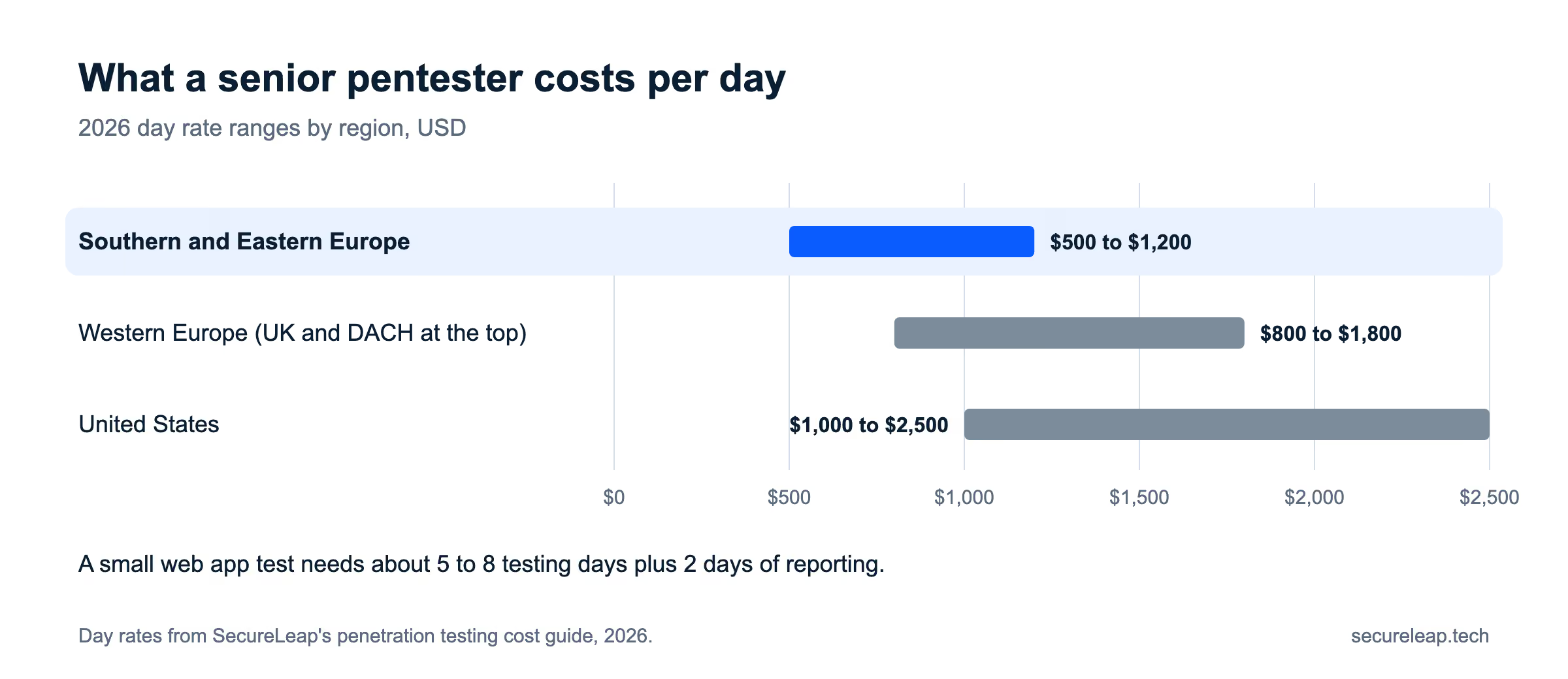
A pentest quote comes down to three numbers: scope, tester days and day rate. Senior pentester day rates in 2026 run $800 to $1,800 in Western Europe, with the UK and DACH at the top of that range, and $500 to $1,200 in Southern and Eastern Europe. A small web app needs about 5 to 8 days of testing plus 2 days of reporting, which is why most seed and Series A startups pay $4,000 to $12,000 per test. Our penetration testing cost guide breaks this down by test type.
Prices published by companies on this list:
- SecureLeap: from EUR 3,999 per test, fixed after a free scoping call, with unlimited retests for 60 days.
- Precursor Security: about £1,200 per tester day, and web application tests from £3,750.
- Pentest-Tools.com: self-serve plans from $96 a month.
- OnSecurity: an estimated quote in its platform, billed by the hour.
The other pentesting companies on the list quote per project. Ask every vendor how many tester days the quote includes and whether retests are in the price: those two lines explain most of the difference between quotes.
How to choose the right penetration testing company
Start from what the test is for, not from the brand. The flow below maps the most common situations to the type of provider that fits.
"Most startups don't need the biggest firm. They need a test sized to their product, a report their auditor accepts the first time, and a retest that proves the fixes held," says Marçal Santos, CISO and founder of SecureLeap.

- An auditor or enterprise customer wants a report this quarter: a fixed-scope manual test with retests included (SecureLeap, Precursor Security, Vaadata, Tripla Consult). For most startups, the first test is a grey box test of the main web app and its API.
- You release every week and want testing in between: a continuous testing platform (Outpost24, OnSecurity).
- You test UK government or critical national infrastructure systems: a CHECK company (WorkNest Secure, NCC Group).
- You are a large enterprise, or a financial entity selected for DORA threat-led testing: a large consultancy (NCC Group, Redscan or SySS).
- You have security engineers who will run the tools: a self-serve platform (Pentest-Tools.com), alongside a yearly manual test.
Not sure which test you need? Types of penetration testing explains the options, and our penetration testing guide for startups covers scoping, timing and preparation.
Red flags when comparing pentest quotes
- No tester days in the quote. If a quote doesn't say how many days of manual testing it buys, or it sits far below the day-rate math above, you are probably buying an automated scan.
- No retest. Without one, you have a list of problems but no evidence that they were fixed, which is what auditors and customers ask for.
- Accreditations you can't check. Look up every CREST, CHECK, PASSI or BSI claim in the official register before you sign.
- No named testers. You should know who will test your systems, and which certifications they hold, before work starts.
- No sample report. Ask for a redacted one. It should show scope, dates, method, findings with severity and reproduction steps, and retest results. Our pentest report guide shows what to look for.
FAQ: penetration testing companies in Europe
What are the top 5 penetration testing companies in Europe?
For startups and small companies, the top five on this list are SecureLeap, Vaadata, Precursor Security, OnSecurity and Tripla Consult. For large enterprises and regulated multinationals, NCC Group, Redscan (Kroll) and SySS are the stronger fit.
How much does a penetration test cost in Europe?
Most startups pay $4,000 to $12,000 to test one web app and its API, based on senior day rates of $500 to $1,800 across Europe. SecureLeap starts at EUR 3,999 per test, with unlimited retests for 60 days.
Do I need a CREST-accredited penetration testing company?
Only if a customer, regulator or UK public sector contract asks for it, because SOC 2 and ISO 27001 do not require CREST. Auditors check the scope, method, findings and retest evidence in the report, so certified testers and a clear report matter more for most startups.
How long does a penetration test take?
Testing one web app and its API takes about 5 to 8 days, plus 2 days of reporting. At SecureLeap, most engagements start within 2 business days.
Does NIS2 or DORA require penetration testing?
NIS2 does not make penetration testing mandatory by name, but Article 21 requires procedures to assess whether your security measures work, and a pentest is the usual evidence. DORA requires threat-led penetration testing at least every three years for financial entities selected by their regulator.
Get a fixed quote for your pentest
If you are a startup or small company preparing for SOC 2, ISO 27001 or a customer security review, book a free 30-minute scoping call. You get a fixed price for your scope (from EUR 3,999) and unlimited retests for 60 days, and most engagements start within 2 business days.